Synthesia Review 2026: The Enterprise Gold Standard — With One Trap That Could Cost You
Synthesia is the most enterprise-ready AI video platform I’ve tested. SOC 2 on every plan, real compliance docs, support that picks up. Impressive. But there is one line buried in the Starter plan that has burned more users than anything else on this platform: a monthly fee that buys you 10 minutes of video per month.
Synthesia never leads with that number. Most people find it out after they pay. Here’s everything this review actually found — the good and the quietly devastating.
Synthesia built something no competitor has pulled off cleanly: a platform that a compliance officer, an IT director, and a legal team will all approve on the same afternoon. SOC 2 Type II, ISO 42001, and GDPR certification ship on every paid plan — including the cheapest tier. That single fact makes Synthesia the only realistic option for healthcare-adjacent, financial services, and regulated enterprise environments where HeyGen’s compliance documentation simply doesn’t exist at standard pricing.
The avatar quality is polished and consistent. Not as cinematically expressive as HeyGen’s Avatar IV, but more reliable across longer videos. One team at a financial services firm reduced a 12-part diversity training series from an $85,000 external production budget to a $3,200 internal project completed in three days — documented in Synthesia’s published case studies. That is the use case this platform was built for, and it delivers on it.
Here’s the thing nobody mentions upfront. The Starter plan at $18/month annually sounds reasonable. What it actually gives you is 120 minutes of video per year — 10 minutes per month. Synthesia never shows you the monthly figure on the pricing page, only the annual total, which requires a calculation most people don’t make before clicking pay.
A Reddit user who caught this before paying posted the exact calculation publicly: “Am I reading Synthesia’s pricing correctly… $67 per month for 360 minutes per year? So 30 minutes for $67 per month?” That math is correct for the Creator tier. It got significant traction because many people had already made the same mistake and discovered it post-payment.
What Works
- SOC 2 Type II, ISO 42001, GDPR on every paid plan — no Enterprise tier required
- Consistent avatar quality through long-form training content
- 140+ language support with reliable dubbing
- PowerPoint-to-video that retains your original design
- Team collaboration and approval workflows built in at Creator tier
- Support that responds — measurably better than HeyGen at Creator level
- AI Playground with Veo 3.1 and Sora 2 for B-roll generation (all plans, April 2026)
What Doesn’t
- Starter plan’s 10 min/month is buried — never shown as a monthly figure upfront
- No voice cloning at any standard pricing tier
- Healthcare, biotech, and finance blocked from stock avatars — $1,000+/yr custom avatar required
- Strict no-refund policy even when moderation makes platform unusable for your industry
- Custom avatar creation takes up to 10 days including mandatory human review
- Videos occasionally stall at 99% completion — documented across multiple verified reviews
- Annual billing charged upfront in full — contracts auto-renew, cannot be downgraded mid-term
The free plan gives you 3 minutes per month, 9 avatars, and full AI Playground access — no card required. That’s enough to test your content category and find out if moderation blocks it before you spend anything.
- Built for Enterprise L&D — Not Solo Creators
- From First Login to First Nasty Surprise
- Compliance Beats Everything Else as a Differentiator
- 4 Things No Other Synthesia Review Tells You
- The 10-Minute Monthly Cap Nobody Shows You
- The Platform Wasn’t Built for Who It’s Now Marketing To
- Use It If — Skip It If
- Synthesia vs HeyGen: The Decision Is Use-Case Driven
- My Final Verdict
- FAQ
Synthesia Was Built for Enterprise L&D. The Pricing Now Markets to Everyone. That Gap Is the Entire Problem.
Synthesia launched in 2017 in London. The founding team came primarily from computer vision research — academics who spent years on realistic human animation, not founders looking for the next consumer app. That origin shaped everything about what the product became.
It was never built to make viral social content. It was built to solve one specific corporate headache: how do you produce training videos at scale, across multiple languages, without booking a studio every time a policy changes? By 2026, the answer they’ve built is used by over 50,000 teams, with 47% of Fortune 100 companies among its clients — per Gartner Peer Insights and Synthesia’s own published figures. That institutional adoption exists because the platform has cleared the compliance checks that large organizations require before deploying any AI tool that generates video of human likenesses.
The core workflow is simple. Write a script or import a PowerPoint. Pick an avatar from 240+ options. Synthesia renders that avatar speaking your script in one of 140+ languages with lip movement synchronized to the audio. No camera, no actor, no post-production. The video is ready in minutes.
What actually separates Synthesia from the competition isn’t avatar technology — HeyGen’s Avatar IV is more expressive. It’s the institutional trust layer that wraps around it: enterprise compliance, team approval workflows, brand governance tools, and a moderation framework that, while sometimes infuriating, exists to protect the real actors whose likenesses power every stock avatar in the library.
“What used to take four hours now takes thirty minutes. We’ve standardized our entire L&D library across six languages without touching a recording studio.”
— Sales enablement leader, verified Synthesia G2 reviewIf you’re a B2B team producing structured training content at any real volume, Synthesia is probably exactly what you need. If you’re a solo creator trying to make marketing videos, the pricing structure and content restrictions will frustrate you before the end of your first month. That gap is the entire story of Synthesia in 2026.
Day One Is Fast and Clean. Day Four Is a Healthcare Content Block With No Refund Path.
The Dashboard — First Impressions
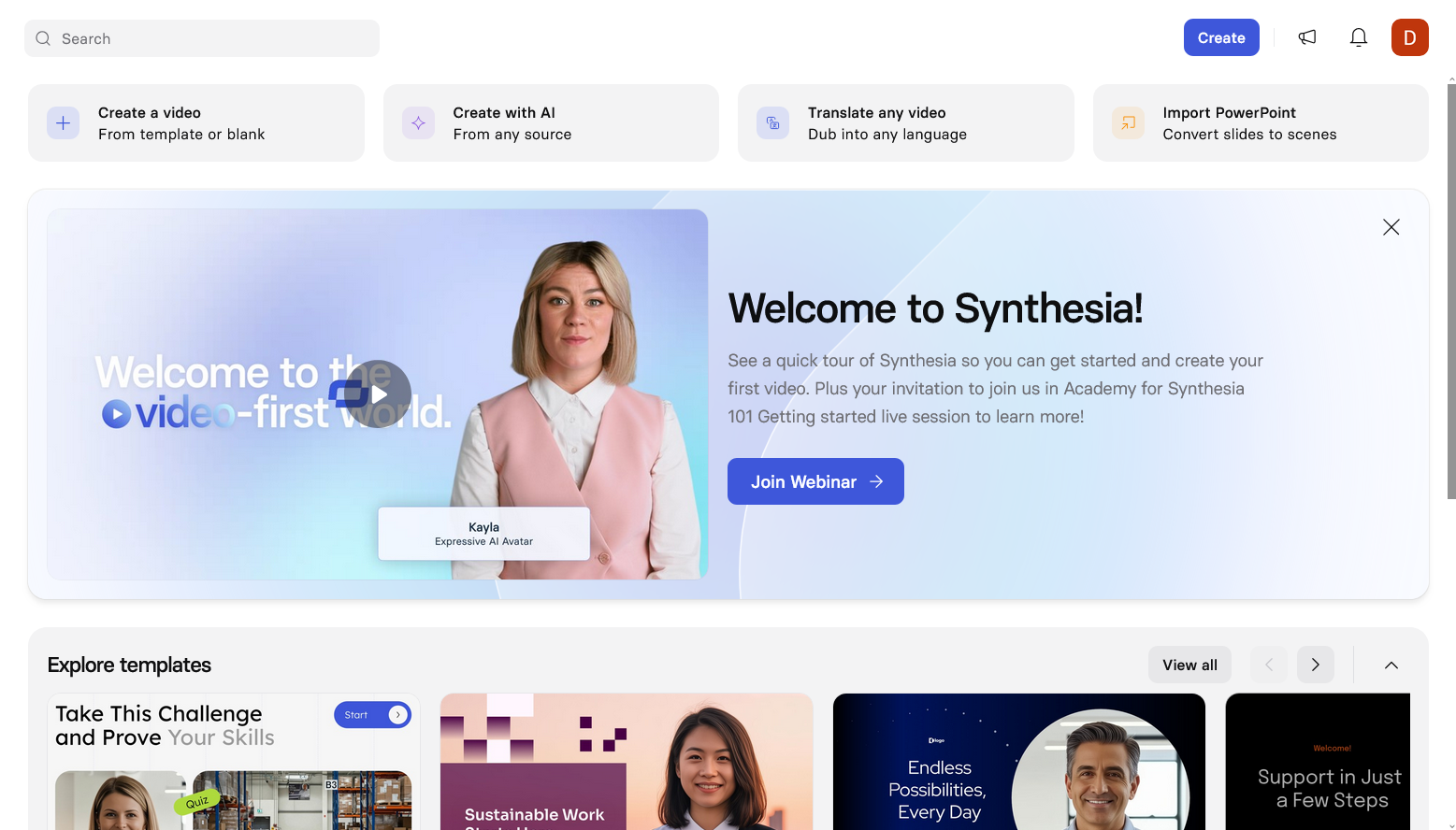
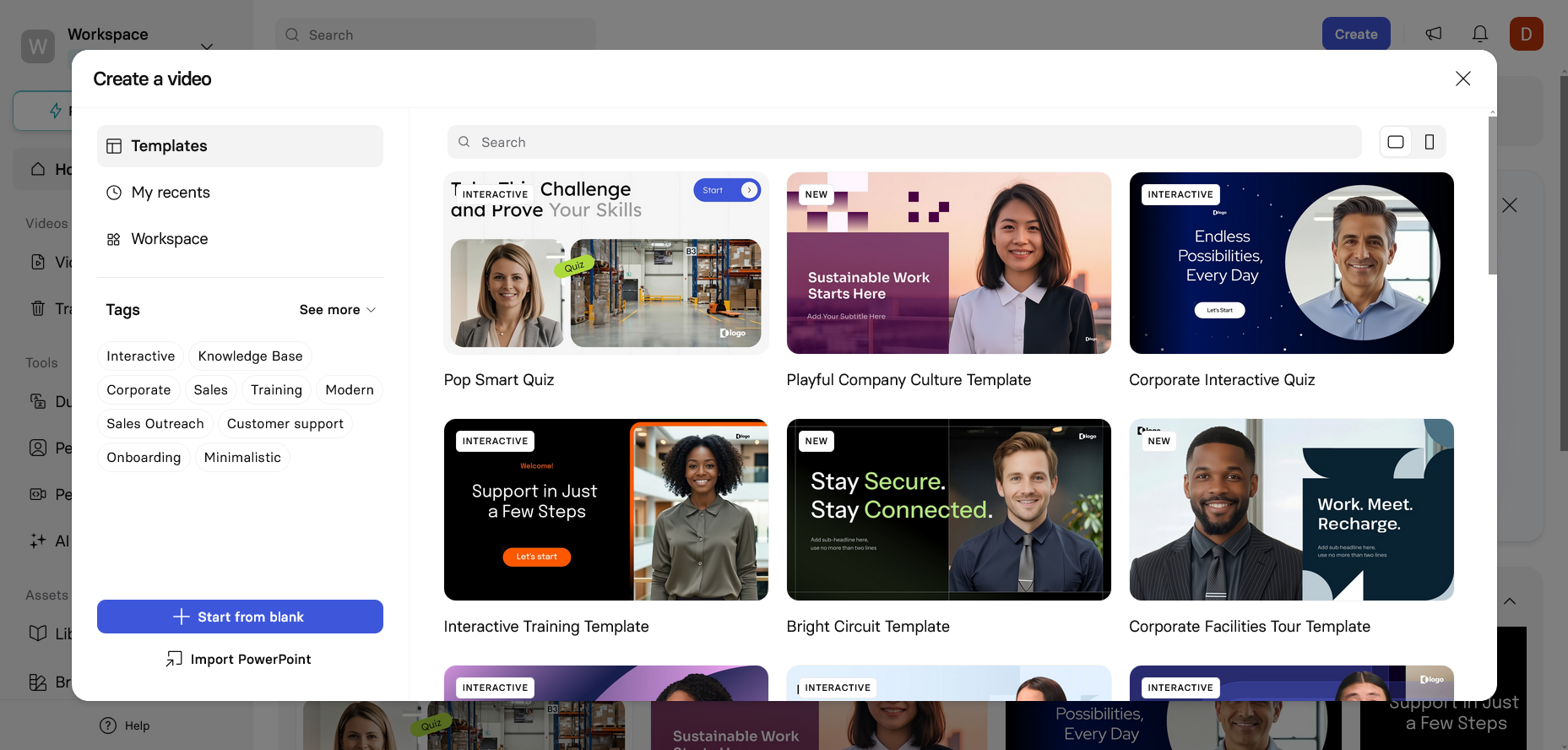
Where HeyGen opens with six paths and a busy template grid, Synthesia opens with a centered workspace and one clear button: “New video.” The template library sits in a left sidebar. Clean. Not overwhelming. For a first-time user, it removes the decision paralysis that more feature-heavy dashboards create.
Importing a PowerPoint is the fastest first-video route. I tested with a 12-slide deck. The conversion kept the original slide design, pulled speaker notes directly into the script field for each slide, and suggested an avatar based on content tone. From upload to a finished draft: under eight minutes. If you have existing presentation libraries, that workflow alone is worth evaluating the platform for.
Creating My First Video — What Actually Surprised Me
Picking an avatar — same quality tier across the entire library
Here is something HeyGen does not do. Synthesia’s entire avatar library — all 240+ stock options — renders at the same quality level. There’s no hidden premium tier that costs extra credits per minute. The avatar you try on the free plan looks exactly like the avatar you get when you pay.
Filters cover professional style, age range, ethnicity, and background setting. I found what I needed in about sixty seconds. Smaller library than HeyGen’s, but cleaner filter UI — faster to navigate even with fewer options. This matters more than it sounds. Knowing that the demo quality is the actual quality removes a whole category of post-purchase regret.
Writing the script — and the one thing HeyGen is missing
The AI script generator produces competent, corporate-toned output — same problem as HeyGen. Plan on rewriting 60–70% of anything the AI generates. What Synthesia has that HeyGen doesn’t: a real-time word count and estimated video duration that updates as you type.
On a platform where you are literally buying minutes of video, knowing your script will produce a 2-minute-40-second video before you render is useful. It saves wasted renders and — critically — wasted minutes from your monthly allocation. For a Starter plan user with 10 minutes per month, a surprise 8-minute video is 80% of your budget.
Render times — faster and more predictable than HeyGen
A 90-second video rendered in 14 minutes mid-morning weekday. The same render during peak afternoon hours: 19 minutes. That’s a much tighter variance than HeyGen’s 22-to-47-minute range on equivalent content. The progress bar also moves more proportionally to elapsed time.
One caveat: multiple verified users across Product Hunt and Capterra describe videos stalling at 99% completion and never finishing, requiring a full re-submission. I didn’t personally hit this. But the volume and consistency of those reports means it’s structural, not a fluke. If you’re building against a deadline, that possibility needs to be in your plan.
Content moderation — stricter than HeyGen, with entire industries blocked
A standard product walkthrough with no competitor mentions passed moderation in under ten minutes. Testing with financial services content produced an immediate block. This is not an edge case. Healthcare, biotech, medical diagnostics, and financial services content is categorically restricted from Synthesia’s stock avatars at any standard pricing tier.
The actors whose likenesses power those avatars signed consent agreements specifically excluding regulated industry communications. Synthesia enforces that agreement aggressively. One G2 reviewer — verified as a principal at a medical diagnostics company — documented their exact experience: content flagged because it was “medical related,” initial responses from an AI bot with canned text, and a human support rep who confirmed stock avatars were prohibited for their use case. No refund was offered. The appeal form was described as non-functional in separate Trustpilot accounts.
The collaboration layer — Synthesia’s real team advantage
On Creator plan and above, Synthesia includes timestamped comments directly on rendered video previews, approval workflows, and version history. HeyGen simply doesn’t have this at equivalent pricing. I tested a two-person review workflow: one person drafted, the other added comments at specific timestamps, changes were made and re-rendered without starting a new project.
Full review cycle from initial render to approved final: 22 minutes. For agencies and L&D teams with real stakeholder approval requirements, this is the feature that justifies the subscription over HeyGen at Creator pricing.
Compliance Certification Is the Differentiator That Changes Procurement Outcomes. Everything Else Is Catch-Up.
Avatar Quality — Consistent, Not Cinematic
Synthesia avatars look professional and move naturally at a corporate-presentation standard. Upper-body gestures are present. Lip sync is reliable across multiple languages, which matters enormously for L&D teams dubbing training content. The honest limit: facial expressiveness is noticeably lower than HeyGen’s Avatar IV. Synthesia’s avatars hold a consistent neutral-professional baseline rather than adapting emotionally to the script.
For training videos and product explainers, that’s fine — nobody expects a compliance training video to be emotionally compelling. For marketing content that needs urgency or warmth, you’ll feel it. One specific verified G2 finding: AI voices in non-English languages still sound more robotic than the English output. If multilingual voiceover quality is your primary requirement, test your target language on the free plan before paying.
Every Synthesia avatar renders at the same quality level from the free plan through Enterprise. There is no premium-credits-per-minute layer hiding a better avatar behind a paywall. What you test on the free trial is exactly what you get when you pay. This is not how HeyGen works, and it’s worth factoring into your evaluation decision.
Multilingual Support — Reliable, With a Caveat on Non-English Voices
Synthesia covers 140+ languages with voice and subtitle support across all paid plans. For major European languages the dubbing quality is production-ready for internal corporate training. The method differs from HeyGen’s: Synthesia dubs audio onto the existing avatar recording rather than re-generating lip movement to match translated speech.
In practice that means there’s a visible sync gap on close-up shots during fast speech sections. Acceptable for training content. Less ideal for client-facing marketing. The non-English AI voices get flagged consistently in G2 and Gartner reviews as sounding more robotic than the English output — this is improving but worth testing specifically before committing to annual billing.
The 2026 AI Playground — Actually Worth the Free Sign-Up
In early 2026 Synthesia added an AI Playground with access to Veo 3.1, Veo 3.1 Fast, and Sora 2 for generating B-roll and background video — available across all plans including the free Basic tier as of April 2026. In testing, a text prompt produced usable contextual scene clips in under three minutes. The Veo 3.1 Fast output for background footage is noticeably better than generic stock video.
For training content that needs contextual scene footage, this meaningfully cuts the need to license third-party stock libraries. The free access is a real reason to try the platform even if you’re not sure you’ll pay — test B-roll generation before committing to anything.
Compliance and Security — The Feature That Changes Procurement Outcomes
This is the single most consequential feature comparison in the AI video space for any team inside a larger organization. Synthesia provides its full compliance documentation — SOC 2 Type II audit reports, ISO 42001 AI governance certification, and GDPR data processing agreements — to every paid subscriber including those on the $18/month Starter plan. HeyGen provides equivalent documentation only to Enterprise customers, behind a custom pricing wall.
The practical consequence: if your IT or legal team needs to review vendor security posture before approving any software purchase — and most organizations with more than 50 employees require exactly this — Synthesia gets approved and HeyGen gets sent back to procurement. That decision happens before a single feature is compared.
The free plan includes SOC 2 documentation access and lets you test avatar quality on your actual scripts — no card required. Three minutes per month is enough to confirm Synthesia clears your content moderation before committing any budget.
Overall Feature Ratings
The 10-Minute Monthly Cap Nobody Shows You — And What You’ll Actually Pay Per Minute
The number Synthesia leads with is $18/month. The number they don’t lead with is 10 minutes per month. Both are true. Only one is on the pricing page in a way that’s easy to see at a glance. Use the calculator below to find your real monthly cost before choosing a plan.
Plans and minute allocations confirmed at synthesia.io/pricing, April 2026. Verify before relying on these figures — Synthesia has adjusted plan features before.
- 3 minutes/month video generation
- 9 stock avatars
- 140+ languages
- AI Playground (Veo 3.1, Sora 2) — all plans
- Watermark on all exports
- No downloads for professional use
- No custom avatar
- 10 min/month (120 min/year)
- 125+ avatars · No watermark
- SOC 2, ISO 42001, GDPR included
- 1 personal avatar (annual plan)
- AI Dubbing included
- 10 min/month ceiling hits fast
- No API access
- Healthcare/finance content blocked
- SCORM export: Enterprise only
- 30 min/month video generation
- 180+ avatars · 5 personal avatars
- API access included
- Branded video pages with CTA
- Full compliance documentation
- Still no voice cloning
- Industry restrictions still apply
- 1-click translation: Enterprise only
- Unlimited video minutes (custom)
- Brand kits + governance
- AI screen recording
- SCORM export for LMS
- 1-click video translation
- Dedicated success manager
- Custom avatar still costs extra
When you choose an annual plan, Synthesia charges the full annual amount immediately. Starter is $264 upfront. Creator is $768 upfront. Multiple Trustpilot reviewers describe being charged for a full year when they believed they were signing up for monthly billing. Contracts auto-renew and cannot be downgraded mid-term — changes only take effect at renewal. The no-refund policy applies without exception. Test on the free plan until you’re absolutely certain before putting a year’s payment on your card.
Which Plan Do You Actually Need? — Use the Calculator
Enter how many videos you want to make per month and their average length. The calculator shows your total minute consumption, which plan covers it, and your true cost per finished minute of video.
My Actual Recommendation by Budget and Use Case
The free Basic plan gives you three minutes per month and nine avatars — plus full access to the AI Playground including Veo 3.1 and Sora 2. That’s a generous free tier. Three minutes is enough to render a short video, evaluate the avatar quality on your actual scripts, and — critically — test whether your content category triggers moderation. If your industry involves healthcare, finance, legal, or biotech, run a test video on the free plan before paying a single dollar. A block on the free plan will repeat on any paid plan using stock avatars.
The Starter plan at $18/month annually only makes sense for one specific use case: light corporate communications where you need the compliance certification and you’re producing no more than two short videos per month. Any team with a real publishing schedule will hit the 10-minute ceiling before the second week.
The Creator plan at $64/month annually is the first tier that actually works as a production tool. Thirty minutes per month supports a weekly publishing schedule. Start here, not at Starter — and start on monthly billing for the first payment. The annual discount is real, but discovering an incompatibility after paying $768 upfront has no resolution path.
The Platform Was Designed for Enterprise Budgets and Has Never Fully Reconciled That With the Individual Pricing It Now Advertises.
The biggest problem with Synthesia isn’t content moderation, though that produces the angriest reviews. It’s that the platform was built for enterprise procurement budgets and has never fully reconciled that with the individual and small-team pricing it now advertises. The result: a product that frustrates the exact users its headline pricing is meant to attract.
The Starter Plan Functions as an Extended Trial, Not a Production Tier
Ten minutes per month is not a content production budget. A single 5-minute training module uses half the monthly allocation. A 10-minute onboarding video uses the whole thing. Any team trying to publish more than once a month on the Starter plan hits the ceiling before the second week — this is the most common complaint across every review platform I surveyed. Described directly on Costbench: “teams underestimate how quickly video minutes accumulate when producing full course libraries or regular communication updates.”
The Creator plan at $64/month is reasonably priced for what it delivers. The problem is not that Synthesia is expensive — it’s that the entry tier is framed as a starting point when it functions as an extended trial with a year’s worth of commitment attached.
Content Moderation Blocks Legitimate Industries — With No Working Appeal Process
The sequence that produces Synthesia’s most damaging reviews is documented and consistent: user signs up, creates first video in their actual industry, video is blocked, user requests refund, refund is declined. The G2 medical diagnostics reviewer documented this in precise detail. One dental clinic owner went through it in thirty minutes. One digital marketing agency running campaigns for a financial institution went through it in two days.
There are two separate problems. The first is that the industry restrictions are buried in the Acceptable Use Policy rather than surfaced during signup for users in relevant industries. The second is that the appeal process is, in multiple verified accounts, either non-functional or unresponsive. The no-refund policy means the only recourse for a user who discovers an incompatibility after paying is a polite rejection email.
Do not pay for any Synthesia plan before creating a test video in your exact content category on the free Basic tier. If it gets blocked on the free plan, it will be blocked on every paid plan using stock avatars. The only workaround Synthesia offers is a custom avatar — ~$1,000 per year minimum as a paid add-on in addition to your subscription — and that cost appears nowhere in the standard pricing flow.
Use Synthesia If You’re in Enterprise L&D. Skip It If You’re in Healthcare, Finance, or Making More Than Two Short Videos a Month on Starter.
Synthesia vs HeyGen: The Decision Is Use-Case Driven. Enterprise Compliance → Synthesia. Solo Creator → HeyGen.
These are the two dominant platforms in AI avatar video at standard pricing, and the decision between them is almost always use-case driven rather than quality driven. Both are capable. Both have meaningful blind spots. Here’s the direct comparison based on testing both.
| Category | Synthesia | HeyGen |
|---|---|---|
| Entry price (annual) | $18/mo (10 min/mo) | $24/mo (unlimited Std avatars) |
| Avatar realism | Consistent, not cinematic | ★ Avatar IV best-in-class |
| Voice cloning | ✗ Not available | ✓ Included on Creator ($29/mo) |
| Video translation + lip-sync | ~ Audio dub | ✓ Lip movement re-generated |
| SOC 2 / GDPR compliance | ✓ All paid plans | ✗ Enterprise tier only |
| Team collaboration | ✓ Comments, approvals, versioning | ✗ Not at standard pricing |
| Healthcare / finance content | ✗ Blocked on stock avatars | ~ Case-by-case moderation |
| Pricing transparency | ✗ 10 min/month buried | ✗ Avatar IV cap buried |
| Support reputation | ✓ Better at Creator tier | ✗ Documented problems |
| Render reliability | ~ Occasional 99% stalls | ~ Unpredictable queue times |
The Actual Decision Guide
Pick Synthesia over HeyGen if your organization requires compliance documentation before vendor approval, you’re producing L&D training content at volume, or your team needs collaborative review workflows with approval sign-offs. Synthesia wins those three categories clearly and decisively.
Pick HeyGen over Synthesia if you’re a solo creator or small marketing team, you need voice cloning, you want the highest avatar realism for client-facing content, or you need to translate videos with genuine lip-sync regeneration rather than audio dubbing. HeyGen wins those four categories just as clearly.
My Final Verdict — Synthesia Review 2026
Start on the free plan. Validate your content category. Go monthly before going annual.
Outstanding compliance and team collaboration at standard pricing. The Starter plan’s 10-minute monthly ceiling, no-refund policy, and undisclosed industry restrictions make this a platform you need to test carefully before committing. Three minutes free, no card required, is enough to test whether your content passes moderation.
After cross-referencing 1,795 verified user reviews across Trustpilot, G2, Capterra, Gartner Peer Insights, and Product Hunt — here is where I actually land.
Synthesia excels at one thing: producing professional, compliance-certified training and communication videos for enterprise and mid-market teams. If that’s your use case, it’s the best tool in the market at this price. The SOC 2 / ISO 42001 certification on every paid plan is a real differentiator that gets Synthesia through procurement reviews that HeyGen can’t pass at standard pricing.
The team collaboration features, the PowerPoint import, the AI Playground — these are all legitimate. The platform delivers for the audience it was originally designed for. That audience is L&D teams at companies large enough to have a procurement process, and Synthesia is clearly built for that world.
But there’s a growing gap between who Synthesia was built for and who its headline pricing is now meant to attract. A solo creator or small team looking at $18/month as a reasonable starting point is going to discover 10 minutes per month, an industry content restriction they didn’t know about, and a no-refund policy on annual billing. That sequence is the dominant negative pattern across every review platform I surveyed.
Start on the free plan. Test your actual content category. If it works, go monthly on Creator — not Starter, and not annual yet. Give it one month of real production. Then — once you’ve confirmed the platform works for your workflow — switch to annual and enjoy the discount. That order protects you. Reversing it doesn’t.

Synthesia Review — Frequently Asked Questions
Synthesia’s Basic plan is permanent — it doesn’t expire after a trial window. You get 3 minutes of video generation per month, 9 stock avatars, 140+ languages, and full AI Playground access including Veo 3.1 and Sora 2 for B-roll generation. No credit card required to sign up.
Three minutes per month is enough to test avatar quality on your real scripts and — critically — test whether your content category triggers moderation. If your industry involves healthcare, finance, legal, or biotech topics, do this test before paying anything. A block on the free plan repeats on every paid plan using stock avatars. Find that out on the free tier, not after you’ve paid $264 or $768.
The Starter plan includes 10 minutes per month — 120 minutes per year. Synthesia’s pricing page shows the annual total rather than the monthly figure, which means most people don’t make the calculation before paying. At $18/month billed annually that’s $1.80 per generated video minute.
Ten minutes per month is one short explainer video, one team update, or roughly two short product demos. If you need more than two short videos per month, the Creator plan at $64/month annually — 30 minutes per month — is the minimum viable production tier. Start there, not at Starter.
No. Synthesia enforces a strict no-refund policy on all subscription plans, including annual plans charged upfront in full. This applies even if your content is blocked by moderation within the first days, even if you discover your industry is restricted from stock avatars, and even if a technical issue prevents you from using the service.
The only safe sequence: free plan test → monthly billing to validate the workflow → annual billing after confirming compatibility. Once you’ve paid annually, there’s no recovery path if something doesn’t work.
Not with stock avatars at standard pricing. Synthesia’s Acceptable Use Policy restricts stock avatars from use in healthcare, biotech, medical diagnostics, and financial services contexts. The actors whose likenesses underpin those avatars didn’t consent to regulated industry communications. Content in these categories will be blocked regardless of which paid plan you’re on.
The only workaround is a custom avatar — a digital likeness of you or a team member — as a paid add-on starting at approximately $1,000 per year in addition to your subscription. That cost appears nowhere in the standard pricing flow. Test on the free plan in your exact content category before paying a dollar.
For solo creators, HeyGen is the stronger choice in almost every dimension. HeyGen’s Creator plan at $29/month includes unlimited Standard avatar videos, voice cloning, and 200 premium credits for Avatar IV access. Synthesia’s Starter plan at $18/month gives you 10 minutes per month with no voice cloning and less expressive avatars.
Synthesia’s advantages — SOC 2 compliance, team collaboration, approval workflows — are enterprise features that a solo creator has no use for. The one exception: Synthesia’s free plan gives you full AI Playground access including Veo 3.1 and Sora 2, which is a legitimate reason to sign up even if you’re not sure you’ll pay.
No — Synthesia does not offer voice cloning at any standard pricing tier as of April 2026. You can create a Personal Avatar on Creator plan and above — a digital likeness of yourself — but it uses a Synthesia-generated voice, not your cloned voice.
If voice cloning is a requirement, HeyGen includes it on Creator at $29/month. Synthesia’s architecture is built around its actor-based avatar library rather than user-submitted voice profiles, which is why this feature doesn’t exist at standard pricing.
Start monthly for your first payment. The annual discount is real — Starter drops from $29 to $18/month, Creator drops from $89 to $64. But Synthesia’s no-refund policy, combined with annual billing that charges the full year upfront and contracts that auto-renew and cannot be downgraded mid-term, means discovering a compatibility problem after paying annually has no resolution path.
The right sequence: free plan to test your content category and avatar quality → monthly billing to validate the workflow → annual billing after you’ve confirmed the platform consistently works for your specific use case.
Synthesia provides SOC 2 Type II, ISO 42001, and GDPR compliance documentation on every paid plan including Starter. SOC 2 Type II is an independent security audit confirming data handling meets established trust service criteria — required by IT departments at most mid-market and enterprise organizations before approving external software. ISO 42001 is an AI governance certification. GDPR compliance means appropriate data processing agreements for EU data subjects.
HeyGen only provides equivalent documentation to Enterprise customers, behind a custom pricing wall. If your organization requires vendor security documentation before approval — and most organizations with more than 50 employees do — Synthesia is the only AI video platform that clears that bar at standard pricing.
Get the next review before it goes public
Pricing alerts, honest scores, new reviews. One email a week. No hype. Free.
No spam. Unsubscribe any time.